
A high-brow garden book with an explosion of ideas for the desert gardener
Many of the world’s most sophisticated gardening styles are born in temperate or sub-tropical environments, making them difficult to translate to a desert garden. Kevin Phillip Williams & Michael Guidi’s book, Shrouded in Light, was born under much harsher conditions. Desert gardeners looking to alleviate their desert garden malaise will appreciate this book.

A true love for shrubs
Williams and Guidi are gardeners and horticulturists connected to the Denver Botanic Gardens, home to some of the Mountain West’s best gardening styles and the innovative plant label, Plant Select. For them, the humble shrub is uniquely worthy of emulation for contemporary gardens. I agree.
The book is partly an ode to shrubs. It is also a theoretical and practical treatment of their place in the wild and in our gardens. Indeed, the authors see something of themselves (and us) in these middling denizens of the garden. “If forbs are fodder and trees are gods, then shrubs are our equals.”
Defining shrubs
The book begins with a primer on shrubs, walking the reader through their unique characteristics. Any sort of biological and botanical instruction is always helpful for gardeners. But it turns out the answer is rather simple: You know it when you see it. Of course, there is more to it. Shrubs have unique morphologies. Their stems and root systems are especially distinctive. The authors’ descriptions of their fruits, leaves, and flowers gave me a greater appreciation for the shrub.
Still, what makes a shrub shrubby is contested ground. They occupy a liminal place in landscapes, often appearing in borderlands. This fact makes them compelling for the authors and the gardener. Our yards are natural borderlands—a collection of intentional and accidental plants, domestic and foreign. Shrubs thrive in this environment.
Shrublands are hotbeds of ecological diversity worth emulating
The most practical section for gardeners seeking inspiration is a tour of shrub ecosystems from around the world. These ecosystems are mostly in North America.
I was surprised and elated to see my “home” shrubland: the arid lands of southeastern Utah. Located between Moab and Monticello, this shrub-steppe planting community is rewarded with several stunning photographs. Williams and Guidi also analyze it for what it can give the gardener: a consistent, durable framework that looks good no matter the season.
Our desert lands get their treatment, with a focus on the Chihuahuan and Sonoran. “Delicateness, exuberance, and danger” are at home here. Both are wetter deserts. The Sonoran’s reliable monsoons and gentle winter rains create ideal conditions for cactus forests and are the envy of Mojave gardeners. But even creosote appears four times in this well-researched book (the index is thorough—making it an excellent reference book). But desert dwellers will have to forgive the authors for comparing our landscape to an S&M fantasyland. The pleasure of the desert is found in its silence, not cries of pain. (There are no safe words in the desert. This place will kill you.)
Shrubs, and the authors, embrace playful contradictions
You are forgiven if, after the first twenty pages or so, you flipped, like me, to the bibliography. I was expecting to see the usual post-structural folks, Derrida or Deleuze, gracing the tiny print. They do not—but the echo is there. Thankfully, it is expressed as a sort of playfulness. The authors have fun with language, only occasionally confusing the materiality of a plant with our perception of it.
Gardening, at least for now, remains fully moored in the material world. A yellow barrel cactus will not grow in the deep, swampy shade of a northeastern garden. Thank you, god. And for that matter, it won’t grow (very well) in the southernmost exposure of a Mojave garden. It needs a nurse plant to protect it while it acclimates to its new environs.
Williams and Guidi embrace a sort of l’art pour l’art when it comes to the garden. “They need not be spaces that reinforce notions of contemporary beauty or be justified by a measurable function that they perform,” the authors argue. They also offer strong, planet-saving reasons to garden with scrub. Shrublands, “hotbeds of endemism,” are among the best templates for cultivating wildlife in our yards. They are thriving ecosystems, and shrubs often give care enough for other plant and animal lives to thrive.
The playfulness of the authors is a fine respite from some of the more prescriptive penchants of garden design. Do this; don’t do that; orange is tacky; fuchsia is whorish. Instead, Williams and Guidi have said yes to the Anthropocene and making the most of it. The result is a naturalistic planting style that desert gardeners will find uniquely tailored to their needs.
There is plenty of design inspiration in this book
You will find no planting plans here. Williams and Guidi offer something much better. They start by turning various dominant shrublands into inspiring archetypes. They then use well-composed photographs and digital markers to deconstruct these photos into more easily recognizable plant masses. These plant masses can then be translated into a planting scheme. Genius, really, and a practical way to incorporate their suggestions into a garden.
For example, take your favorite natural scrubland and make it the basis for a new garden you are planting. Start by identifying the three plants you like most. Then plant them into your existing garden. The authors call this mesh planting. You are essentially filling in all the blank spaces. These spaces often, and unfortunately, create the bulk of a desert garden’s visual mass.
“Wild systems emulation seeks visual examples of surprising actions to inspire the arrangement of a design. […] This is garden-hacking. Using these wild, open-source examples of composition and expression as jumping-off points for planting helps to alleviate the heavy-handedness of the designer and encourages acceptance of wandering and competing plant communities.”
Williams & Guidi
Your neighborhood is full of inspiring examples
My favorite garden in my neighborhood—the dog and I walk by it a few times a week—is a wild and measured shrubscape that I did not know was one until this book. It plays with a few tried and true shrubs and shrubby trees—mesquite, vitex, silver acacia—seen often in our arid landscape. Planted close together, they create a scaffolding of sorts. They shelter lower-growing species and are a backdrop for statement succulents, like saguaro and organ pipe cactus. The effect is wild; given its home in the hot Mojave, it is also clearly a garden.

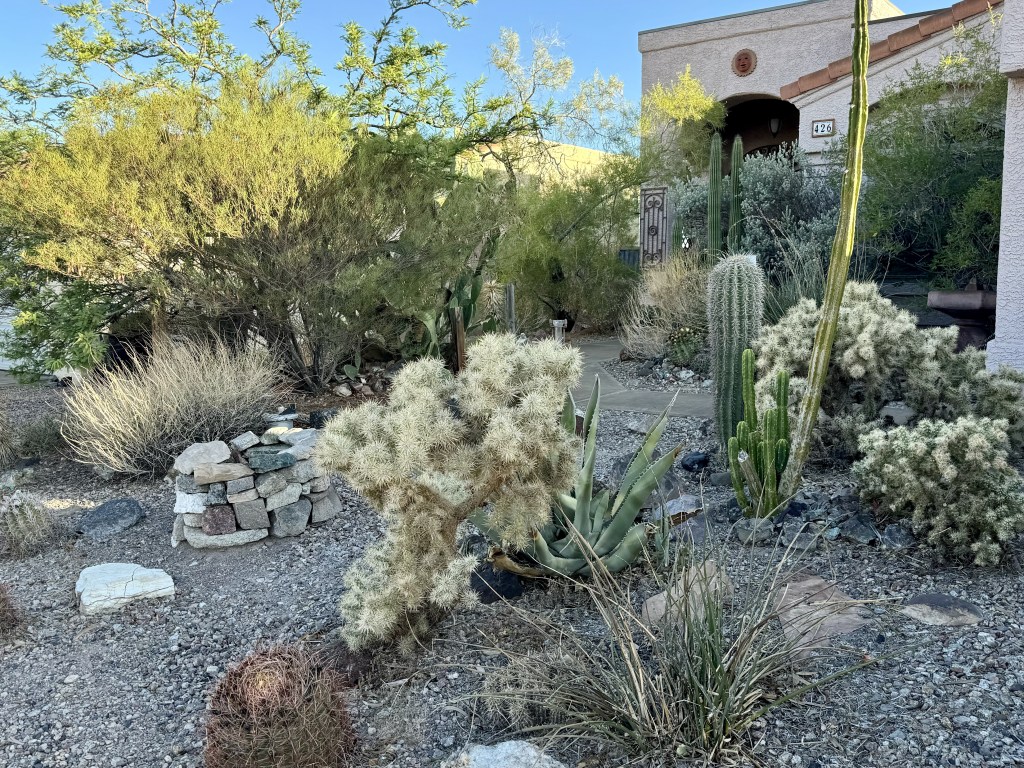
The gardener told me on an early morning walk that he waters with one of those oscillating fan-like sprinklers and only rarely. There is a decorative rain gauge in the middle of his garden to measure precipitation, natural or irrigated. I suspect the garden scaffolding was there when he bought the home—it’s the typical fare for the Las Vegas suburb. His genius was to plant into it a mixture of Mojave and Sonoran-native species. (Sonoran species need summer rains—either natural or planned—and the Mojave species will appreciate it just the same.)
You could try this too
Take a photo of a natural landscape that inspires you and overlay it on a photo of your garden. Then, draw the shapes that mean something to you. Label them with a plant or seed, and then start gardening. If you plan to seed your garden, consider scattering your seeds in mid-summer. That way you can take advantage of the random disbursement of your seeds as they are moved around by violent summer storms.
Or don’t.
But do take a walk through the wash nearest your house and appreciate it. Or take a closer look at the wild garden in your neighborhood. There is plenty to emulate.
“A GARDEN IS A CONSTELLATION OF IDEAS. Gardening is world-making. It should not be easy with simple, linear ideas or outcomes. When emulating shrublands and making shrubscapes we must open our eyes and practice humility.”
Williams & Guidi



 Mojave Gardener