
This tough, native tree will grow just about anywhere
A plant grows through a crack where a retaining wall meets the asphalt of a running trail. Its several stems are splayed, like it has been stomped on. They bear dark green, leathery leaves. The end of each stem is heavy with orchid-like flowers. They are light and dark pink, with splotches of yellow and white, here and there.

It is an adolescent desert willow (Chilopsis linearis). It is arrogant. Surviving there, in those conditions. Blooming now, after months of unabated heat. The monsoons did not come to our neighborhood.
I pause my run and rip a small stem from the little shrub, carrying it with me, like a laurel wreath, a victory all its own. That stem will yield half a dozen cuttings; with any luck, some will take and my garden will be blessed with handfuls of heavy blooms in a few years.
My Mojave garden already has one desert willow. It was a gift from my sister, who grew it by seed. She brought it down from Salt Lake City in a one-gallon nursery pot, a little twig with slender, dark green leaves up and down its small trunk. Over the next few months it easily grew more than a foot.
It blooms spectacularly in late spring, with red magenta blossoms that are patterned like a pink leopard print.
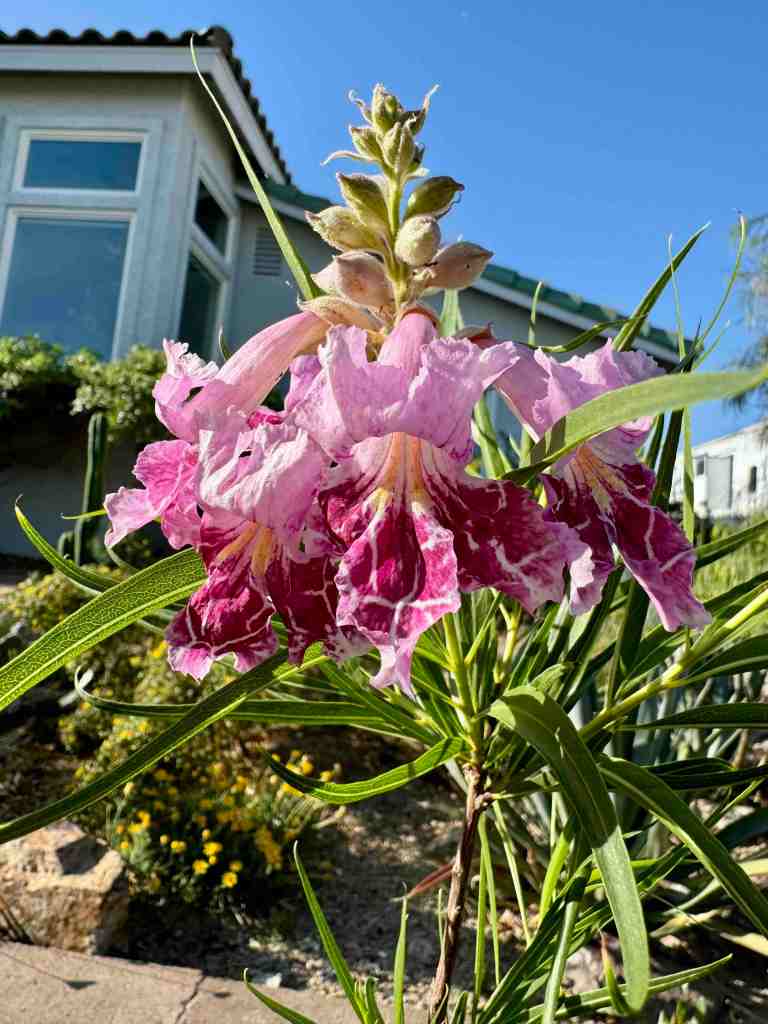
While my desert willow blooms only once, many of the named cultivars will bloom off-and-on all summer. The easiest to find is Burgundy Lace. The flowers are a deep, rich reddish-purple. It rarely produces seed pods, so the plant has tricked itself into repeat blooming in a vain attempt to make seeds.
Monrovia has a cultivar called Timeless Beauty—any large, everblooming variety in southern Nevada is probably of this cultivar. The flowers are paler and tend to wash out in the heat of summer. Which is too bad; this plant should shock you every time you see it.
Some people complain about the seedpods on the wild species. I don’t mind them—they are filled with wispy, silken seeds that scatter in the wind when the pods break open. Some make their way into sidewalk cracks, redeeming these fallen, urban places.
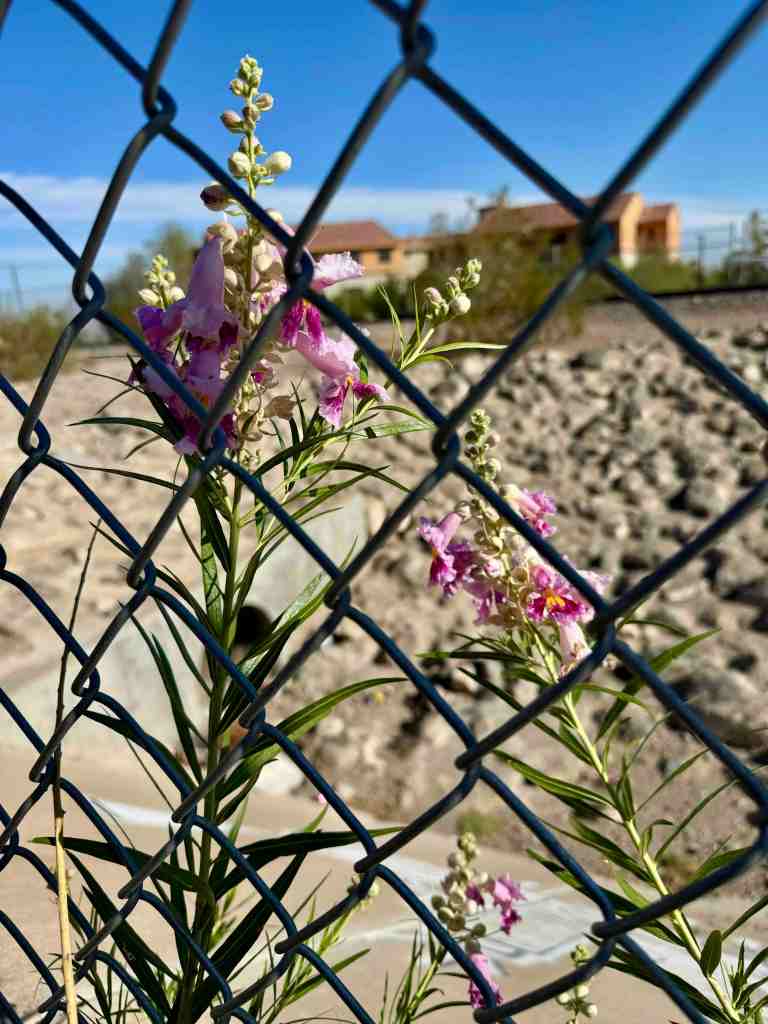
There is wide variation in flower color across the species. My sister grows two in her high altitude desert garden; the flower color is different on each. Hers also are fragrant. This fact of fragrance is a well-known trait, but I can’t seem to notice it. Whatever the scent, it doesn’t grab my attention.
Desert willows have taproots, which make them good candidates for planting in small spaces because their roots grow down rather than out. They are shrubby in their youth, but with careful training they grow into a multi-trunk tree. Desert willows get large if watered to excess; otherwise they remain smaller. Consider withholding water after it reaches your desired size. They grow naturally in washes, which tells you something about their water tastes: rarely and deeply.
Desert willows are deciduous, which means they lose their leaves. Planting this tree in a hot, west-or-south facing courtyard is a good idea. You’ll get shade in the summer, but because it loses its leaves, you’ll get bright, warm sunlight in the winter. Winter light is the desert’s gift to those who live and garden here.
The desert willow has a hybrid child that is planted all over southern Nevada. It is the Chitalpa. This mouthful of a word is the product of a cross between Catalpa and Chilopsis. Think of it as a liger or a mule. Chitalpa is much more tree like, and tends to have a wide canopy. The leaves are also wider, while retaining some of the drought adaptations of our desert willow.
Catalpas, which are plentiful in the old Salt Lake City neighborhood I used to garden in, are large, spooky-looking trees—their limbs bend at odd angles, and their imposing size next to an old house gives the whole scene a haunted feel. They have large leaves, the same orchid-like flower (but white and yellow), and fantastically large pods that are good for swinging about on a walk through the neighborhood.



 Mojave Gardener