

They bloom in winter and need hardly any water at all; hummingbirds love them and many pollinators, too; we should plant more of them in these arid, angry lands
I have often marveled at the different ways succulence evolved. New world succulents, cactus and agave, evolved to be fierce, angry, and armed. Succulents in the old world, particularly Aloe from southern Africa, evolved with some gentleness in their DNA.
Aloe plants may look angry, but they are mostly easy going. Unlike agave and cactus, you are more likely to break an aloe by brushing up against it than it is to break you. (My right pointer finger is still stiff from a recent run-in I had with the glochids of a prickly pear cactus as I was gardening near it just the other day).
Aloes are especially beautiful in our winters. As the temperatures cool and the days become noticeably shorter, Aloes come alive. Many of them do remarkably well here in the low desert. In late winter, their flower spikes start to emerge. They look like pale asparagus spears before stretching and unfolding into soft orange and light yellow flowers, matching almost the color of a fading winter sunrise.

I wish desert gardeners would plant them more. They come in so many shapes and sizes, some as large as trees—though these are harder to grow here. But there are medium shrubby types, while others are as small and fine as clumping grasses. Aloes hybridize freely (which means they breed easily across species) so new varieties can often be found at the garden center. If you plant different kinds of aloes and let them go to seed, you could have an unusual aloe seedling pop up in your own garden.
I’ve made it a habit of growing as many aloes as I can get my hands on. I’ve killed many of them, but many of them thrive.
With the exception of the common aloe, Aloe vera var. barbadenis or chinensis, most aloes prefer some shade in the summer. I once thought Aloe ‘Blue Elf’, a popular hybrid of unknown provenance, could handle a lot of sun; but this summer’s very hot weather proved too hot even for it. I have several clumps in the shade, but they don’t bloom as well.
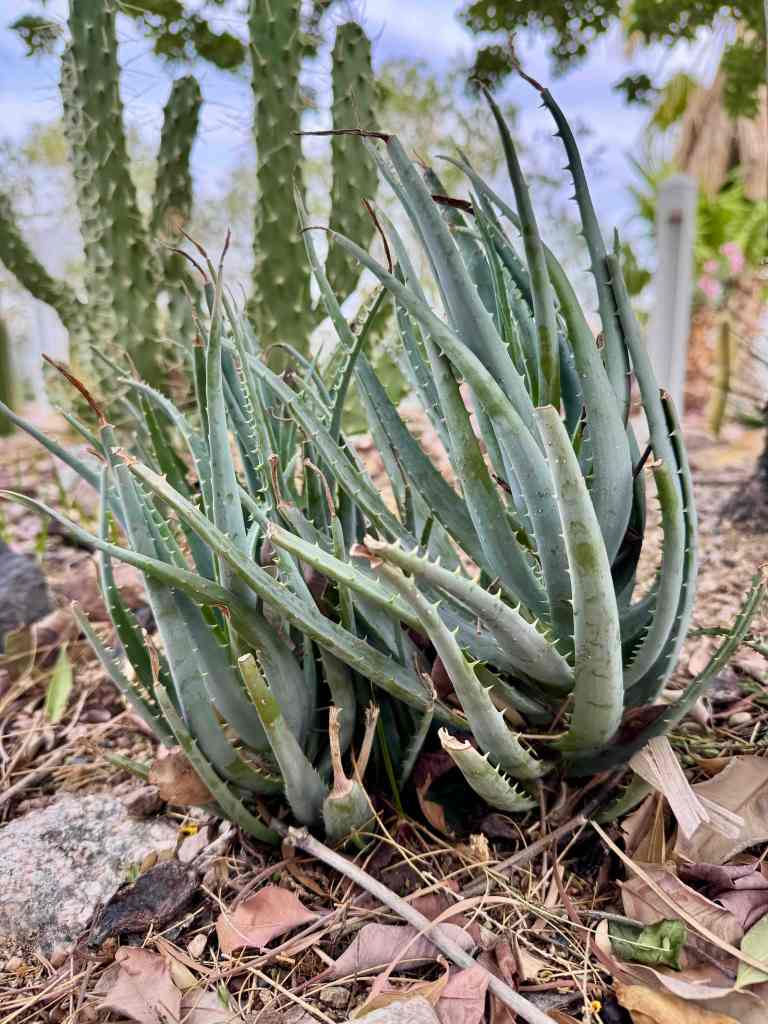
Common Aloe vera, which is medicinal, displays the characteristics of many so-called helping plants, in that it seems to do fine in shade or sun, heat or cold, but it needs more sun to flower.
However, for some aloes, it is not the sun that does them in, but rather the temperatures themselves. A not-too-large Aloe ferox melted on me this summer. The new leaves started to cave in on themselves. Then rot, starting at the top, descended all the way down the trunk. The smell of rotting aloe is awful.
I’ve had other aloes, which I have failed to identify, experience similar fates. Withholding water during the hottest times of year seems to have a protective factor, but a conversation with the horticulturist at the Springs Preserve in downtown Las Vegas confirmed that it was likely heat alone that was responsible for my aloes’ deaths.
A Few Aloes to Try
Zebra aloe (Aloe maculata) does almost too well here. It’s leaves are among the closest you’ll get to variegation in succulents while also doing well in the desert garden. It creates many offsets, quickly filling in a space. The leaves are thick and fleshy and lazy, jutting out in unattractive angles, but it needs almost no care at all and the orange blooms, which are simple, are a nice surprise each spring.

Aloe striata, sometimes called coral aloe or ghost aloe, has been a good performer for me in pots. The flowers, unlike the zebra aloe, are branched and look like apricot-colored candelabras. I grow some in the ground, as well, but they are slow-growing in my rocky, alkaline soil. Aloe striata‘s wide, blue-green leaves make it look like a soft-leaved agave.
Rich, dark greens are often hard to find and grow in our climate, which makes the popcorn aloe (Aloe camperi) a welcome addition to the garden. The flowers, branched and many, are a richer apricot color and a mass of these plants is impressive. In California they obviously grow to excess, but even here the small plant I started a few years ago has started to finally look at home. They need plenty of shade, with some morning light, and they take a while to bloom, depending on the size you have planted.
Still, my favorite is probably the all-too-common Aloe vera var. barbadensis. It is a large, imposing plant with lovely, yellow flower spikes that remind me of kniphofia. The similar, if more diminutive, Aloe vera var. chinensis, blooms too, but its inflorescence is a pale, insipid orange. At least it blooms in winter. The relationship between these two varieties is unclear to me—and with so much hybridization among aloes, who knows how true either of my plants are to the so-called species standard.
Lastly, a small, clumping grass aloe (species unknown) is sometimes available at nurseries. It has done wonderful in a pot for years and blooms from now through spring. I’ve thought that letting it run about in a shady spot of the garden would be marvelous, but I’m worried I will kill it if I put it in the ground. It reminds me of Bulbine frutescens, also native to southern Africa, a plant that is supposed to do well here, but which I have never successfully grown.

Tips for Growing Aloes
Like many arid plants, there is less rigorous horticultural information available than I would like. The best reference I’ve found in English is a book by Raewyn Adams, Aloes A to Z, which provides a comprehensive collection of photos and descriptions, with growing advice for some of them. It is a thorough and welcome contribution to aloe gardening.
But the basics are very similar to new world succulents. Plant aloes as you would other succulents, withholding water at first. But in winter you can water them more when they are flowering.
With the exception of extreme heat, which is out of our control, the trickiest part about growing aloes is that they love our winter sun and hate our summer sun. Growing them successfully requires some creativity as you will want to site them in places that get protection from the summer sun, but that experience lots of gentle, winter light.
For example, growing them under winter deciduous trees (like some mesquite) is smart because they will get full sun in winter, while receiving some protection in the summer.
Aloes are excellent in containers and striking in a patio garden, especially when pots are placed closely and artfully together. On a patio, they do well under shade sails in summer, which can be removed during the winter.
We have several sails in our front courtyard that we take down in the winter; I love soaking up the winter sun among soft-leaved aloes and winter-blooming annuals. Since aloes lack the sharp terminal spines of agave, you needn’t worry about any unintentional injuries.
Like agave, they need little water so you won’t spend your entire summer assuaging their thirst.



 Mojave Gardener