
I have no right to complain; the sun is shining.
It’s a strange time in the desert garden. I feel a bit like Therese, from Patricia Highsmith’s novel, The Price of Salt:
January. It was all things. And it was one thing, like a solid door…January was a two-faced month.
I thought the desert would save me from the sad monotony of this month, “grim as an old man, mysteriously familiar yet unknown, like a word one can almost but not quite define.”
But the old feeling has returned, congregating like salt crystals on my tongue. Even with achingly blue skies and mornings so clear that it doesn’t take much to imagine, as I look out at the great dome that is Mt. Charleston, ancient gods making the world from scratch.

January is a month where you don’t have to garden. Yes, we are halfway through our wettest months with no rain at all, so there is certainly watering, especially of newly planted trees and shrubs and wildflower patches. But there’s no real hurry to it. The weather has finally cooled enough that watered ground retains some of its wetness.
My mind turns to the Colorado River, and I keep thinking I need to get out to it, to hear it and see it and remember that whatever precious molecules that come from my hose have come from it, the lifeblood of this arid land.
I could plant. And I have, of course, made the rounds round the nurseries to see if there is anything new that captures my attention. But the stock at our major independent nursery chain is the same as it has always been. I met a garden designer who has gardened for decades here and she told me that the stock at the nursery-chain-that-must-not-be-named is the same as it has been since 2000, like maybe the Y2K concerns materialized only for them, their computers stuck in 1999. She told me they used to carry Blackfoot daisy and Apache plume, for instance, but I’ve never seen these beautiful desert plants there.
I pulled from the ground an old desert spoon (Dasylirion wheeleri). I had thought it was polycarpic. Perhaps it is. But the one in my front garden, planted there by the previous owners, had flowered the summer before we bought the house and for the last three years it slowly languished until there were no new blue, spiky straps. As I tugged at it I found that it was completely rotted through. Tiny white maggots had made their homes among the layered, shiny, amber remains of many years of leafy accumulations. I pulled the whole thing out, its awkward sheared shape wedged between two dwarf Tecoma cultivars. There is now a giant hole; it calls for something extraordinary.
What will I plant? The area seems to beg for something firmly upright: ocotillo (Forquieria splendens), or one of the dozens of San Pedro I have propagated. If I could get my hands on Stenocerus thuberi (organ pipe cactus) I might try it—our winters are now warm enough it might escape frost damage.
The sun gets me every day into the garden, where I usually settle in a bright spot between the thousands of words I try to crank out on other projects that are not Mojave Gardener. The pool decking seems to catch the sun perfectly now and while the back room where I write is cold, the decking there is warm enough for me to lie down, my eyes closed, hands resting across my chest like I’m a woolen mummy. Winter sun soaks deeply through my thick sweater and knitted beanie.
If I turn my head I have a bug’s eye view of one of the three Mexican fence posts (Pachycereus marginatus) that is planted next to the pool. They seem so strong, right now, their flesh thick, warm, impenetrable, except for the one that is covered with the telltale signs of a cactus bug (Chelinidea vittiger). Little chlorotic halos, as if it has a case of ringworm, dot the poor thing, going all the way up and then halting just before the last foot of new growth. The bug, which I have never found, has died or moved on.
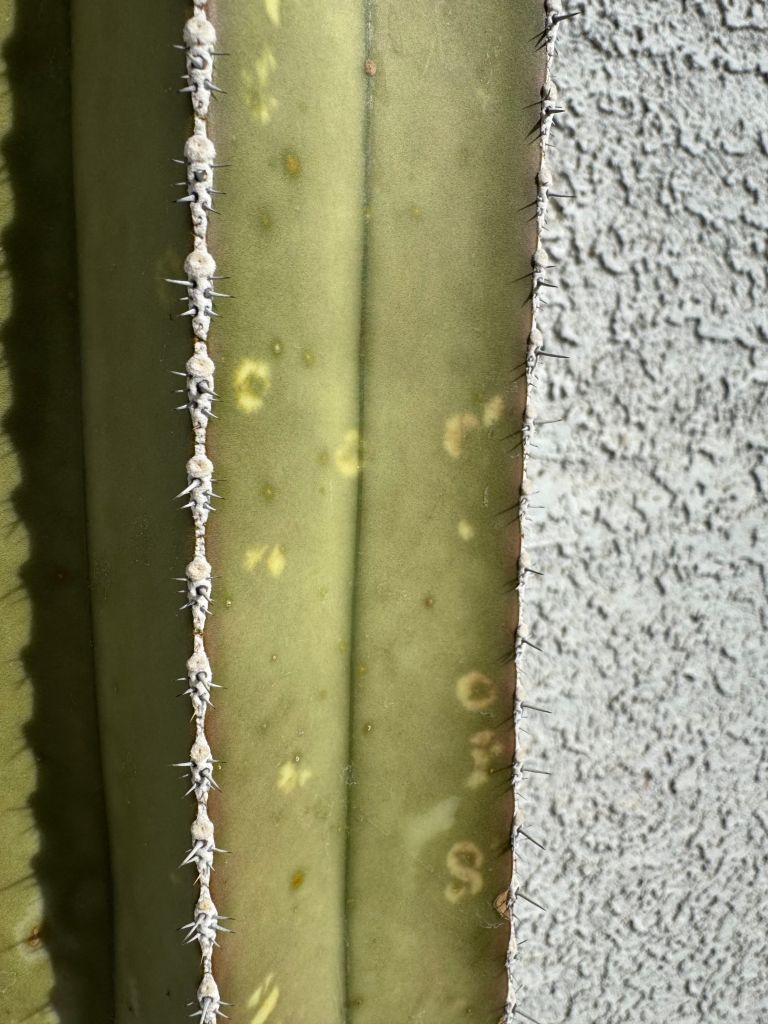
Cactus bugs are funny looking creatures. I saw one on a potted golden barrel cactus (Echinocactus grusonii) and treated it initially as a curiosity when we first moved here. That delay was enough for it to use its piercing, sucking snout to puncture the poor cactus all over, making it look like an unvaccinated, impoverished child. The bug at least kept to the pot, where one afternoon I found it, smashing it, making a deep smear against the smooth terracotta and my gloved hand.
If you see cactus bugs, act immediately. Spray them with water. Mash them. Do not let them move in.


 Mojave Gardener