

Consider, for example, the desert tobacco seedling, Nicotiana obtusifolia, that appeared in my garden earlier this year
Fragility is an essential and surprising quality of our world. It’s also a quality that I hope to embrace more in my garden.
That was one of the surprising lessons I recently learned from reading Leslie Marmon Silko’s book, Ceremony. A book that is not at all about gardens, at least not on the surface.
Ceremony is a 1977 novel about a Pueblo man named Tayo who has returned from World War II with severe post-traumatic stress disorder. In an early chapter in the book, the first of two medicine men visits Tayo to help heal what used to be called battle fatigue. The medicine man tells Tayo that “this world is fragile.” But not in the way we have come to regard that word, as something that is weak. Instead:
“The word he chose to express ‘fragile’ was filled with the intricacies of a continuing process, and with a strength inherent in spider webs woven across paths through sand hills where early in the morning the sun becomes entangled in each filament of web.”
The best gardens are fragile in this way. They are intricate, entangled webs of meaning and living that are not at all weak. They change as sand and sun transform themselves seasonally and the qualities of the plants and people that grow in and under them develop their own rhythms and occupations. A fragile garden is a garden that persists because it is complex. It is strong because it endures drought and wind, and because it is vulnerable to these elements.
Fragile gardens are intricate, self-acknowledging, made, apart from and part of nature. Though they can certainly be low-maintenance, they are hardly abandoned or hands-off. Fragile gardens “demand great patience and love,” to quote Silko.
That great patience and love manifested itself recently in my garden with the appearance of a local tobacco plant, Nicotiana obtusifolia, or desert tobacco.

Desert tobacco grows in creosote scrub and Joshua tree woodland below 4,000 feet, and is especially common on rock fields of desert varnish, according to the wildflower manual I use, Mojave Desert Wildflowers. Which is to say it grows naturally in my backyard.
Before my neighborhood was built in the 80s and 90s, the land here was an alluvial fan guiding runoff from Black Mountain, an extinct volcano that right now is forcing the sun to set much earlier than it otherwise would. The few empty lots that persist in my neighborhood are covered in rocks painted with desert varnish, a black coating that accumulates throughout the Mojave (it can also be red or orange, like it sometimes is in red rock country.)
Desert varnish is itself a fragile, intricate web. “A nanometer scale marriage,” to quote one scientific description of how these petrological features form, “between clay minerals and the millennial accumulation and decay of manganese-and-iron-encrusted bacterial crusts.”
I wonder at the nanometer scale marriages of accumulation and decay that have made my garden home to a desert tobacco plant. It will someday be a beautiful shrub.

For now, it is a low-growing mound. The leaves are dark green, but dusty, a saturated olive green, owing to the fact of millions of tiny hairs that cover the leaf surfaces and catch the light. The flowers, which bloom all year long, are yellowish white to my eye, though some descriptions call them dirty white or greenish white. This difference may be because the plant has been confused for a near look-alike, coyote tobacco (Nicotiana attenuata), which is more widespread, appearing all the way up the west coast into Washington.
N. attenuata and N. obtusifolia seem to be frequently confused for one another in the horticultural literature, and the common names are used interchangeably. For example, in Mojave Desert Wildflowers, N. obtusifolia is given the name coyote tobacco. Flora of North America calls it desert tobacco, and instead gives N. attenuata the common name coyote tobacco.
These plants are similar, but one distinguishing characteristic relates to their style—a tube in the flower that connects the ovary to the stigma. N. attenuata’s style is shorter than the longest stamens; N. obtusifolia’s style just exceeds the longest stamens. There is also the fact of the different colors of the flower. Though the finer gradations of color theory seem subjective, N. obtusifolia is described as having more yellow in its white flowers.
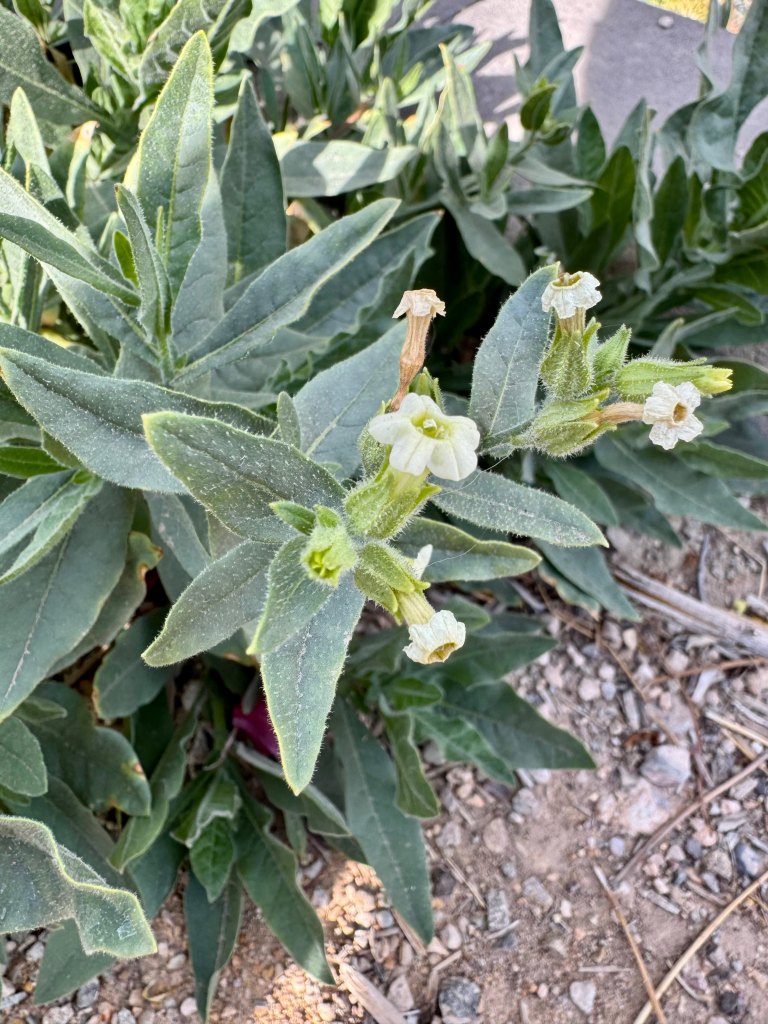
The most telling and charming differences, however, relate to the leaves. N. obtusifolia leaves are lobed at their base, like they are hugging their own stems. I’ve learned this feature is called panduriform, meaning fiddle-shaped. At a closer glance, the leaves of N. obtusifolia look just like a pointier Ficus lyrata leaf. They wrap themselves around their stems, looking like the older leaves on a fiddle leaf fig. N. attenuata leaves are boring, delicate, singly pointed, lacking entirely the gentle and sensual stem-clasping display of N. obtusifolia.
My fragile garden seems healthy with desert tobacco growing in it, even though it has not rained since spring, like the garden has some quality of becoming that did not exist when we first moved here. Then, there was a cabinet in the laundry room full of potions and elixirs and poisons, which we threw out. Then, the garden was a different kind of fragile, intricately connected to chemical corporations and totally alienated from its natural corporation—the millions of bodies, biotic and abiotic, that make a desert garden thrive, that give it a particular varnish, the satisfaction of becoming itself.


 Mojave Gardener